Why Campsite Prices Vary So Much Across Utah State Parks
Comparing Utah state park campsites by nightly price alone can leave you unsure whether a higher rate buys useful amenities or simply reflects a different kind of site. The key is to compare what the price covers, what the campsite provides and what your trip actually needs. Here’s how to read the differences without assuming that every park uses the same pricing logic.
A campsite price is only one part of the comparison
A nightly rate looks simple until you try to compare sites that are not alike. One listing may describe a campsite with hookups; another may offer no hookups. Even if their nightly charges match, the experience and practical value can be different. Conversely, a higher charge may reflect something your group will not use. The price on its own does not tell you whether a site is a good fit.
Start by separating the campground charge from other possible trip costs. Check whether park entry is included, whether you need to pay for a separate service or activity, and whether any booking-related charges appear during checkout. Those details can change the total you plan for, even when the nightly campsite rate is clear. For a broader look at how admission and camping charges fit together, see Entry Fee, Campsite Fee or Both? How Utah State Parks Charge.
A campground charge can include entry, but don’t assume that this applies to every listing or every kind of visit. According to the Utah Division of State Parks and Recreation, the camping charge per night is $45.00 and includes the park’s entry fee. Treat that as a specific rate detail, not as a reason to skip checking the terms attached to the site you are considering.
An annual pass can also affect the way you think about admission, but it does not automatically make a campsite free. The cost of an overnight stay and the cost of entry are not interchangeable. If you already hold a pass, check how it applies to your planned visit and whether the campsite charge remains separate. Annual Pass Holders Still Pay for Campsites at Utah State Parks explains why the distinction matters.
It helps to compare the full trip rather than just the first number you see on a reservation page. Consider the campsite rate, what entry it includes, the amenities you need, and any separately listed charges. Then compare those details against your actual plans. If you expect to spend most of the visit away from camp, some campsite features may matter less. If you plan to cook, sleep and spend downtime at the site, those features can be central to whether the rate feels worthwhile.
Hookups and site amenities can change what a rate means
Hookups are an obvious reason two campsites can offer different practical value. A site with electrical service, water or sewer connections can suit a different style of camping from a basic site without those connections. But the word “hookups” is not enough to judge a listing. Check which services are included and whether they meet the needs of your particular vehicle or setup.
A full-hookup site may be convenient for someone who wants services at the campsite. A partial-hookup site may provide only some of those services, so you may need to plan around what is missing. A no-hookup site can still be the better match if you do not need utilities at the pad, are comfortable managing supplies, or prefer to keep the campsite charge focused on the basics. Compare the actual amenities rather than assuming that every site in a category is identical.
The Utah Division of State Parks and Recreation lists 13 Basin Campground full-hookup sites at Kodachrome Basin State Park; 13 sites available. Max 8 people, 1 vehicle. $45.00. That listing gives useful context beyond the rate: it identifies the type of sites and includes capacity and vehicle details. Those limits matter when deciding whether the site fits your group and camping unit, so read them alongside the price rather than treating the nightly charge as the whole listing.
A partial-hookup Lakeview site is listed at $45.00 / night by the Utah Division of State Parks and Recreation. The matching price does not mean the site offers the same services as a full-hookup site. It is a reminder to compare amenities line by line: a similar charge can be attached to a different hookup arrangement, so a quick glance at the rate may miss a practical difference.
For a closer look at what hookup terms mean for a trip, see Full, Partial or None: Matching Your Rig to a Utah Hookup Site. If your priorities are simpler, Standard Sites Without Hookups: Utah State Park Camping on a Budget can help you think through whether paying for utilities at the site is worth it for your setup.
Amenities beyond hookups also deserve attention. A campsite listing may specify a tent pad, a parking arrangement, nearby facilities or other site characteristics. A feature is only valuable to you if it solves a real need. Someone arriving with a tent may care about the pad and walk from the vehicle; someone in a self-contained RV may focus on site dimensions and access. A family may care about proximity to restrooms, while another group may prefer a quieter or more private setting.
Read the site description, map and rules together. A name or campground label cannot substitute for the details of the particular site. If you are comparing sites with different layouts, Choosing a Campsite in a Utah State Park: Views, Restrooms, Neighbors offers a useful framework for weighing comfort against location.
What the listed rates show, and what they don’t
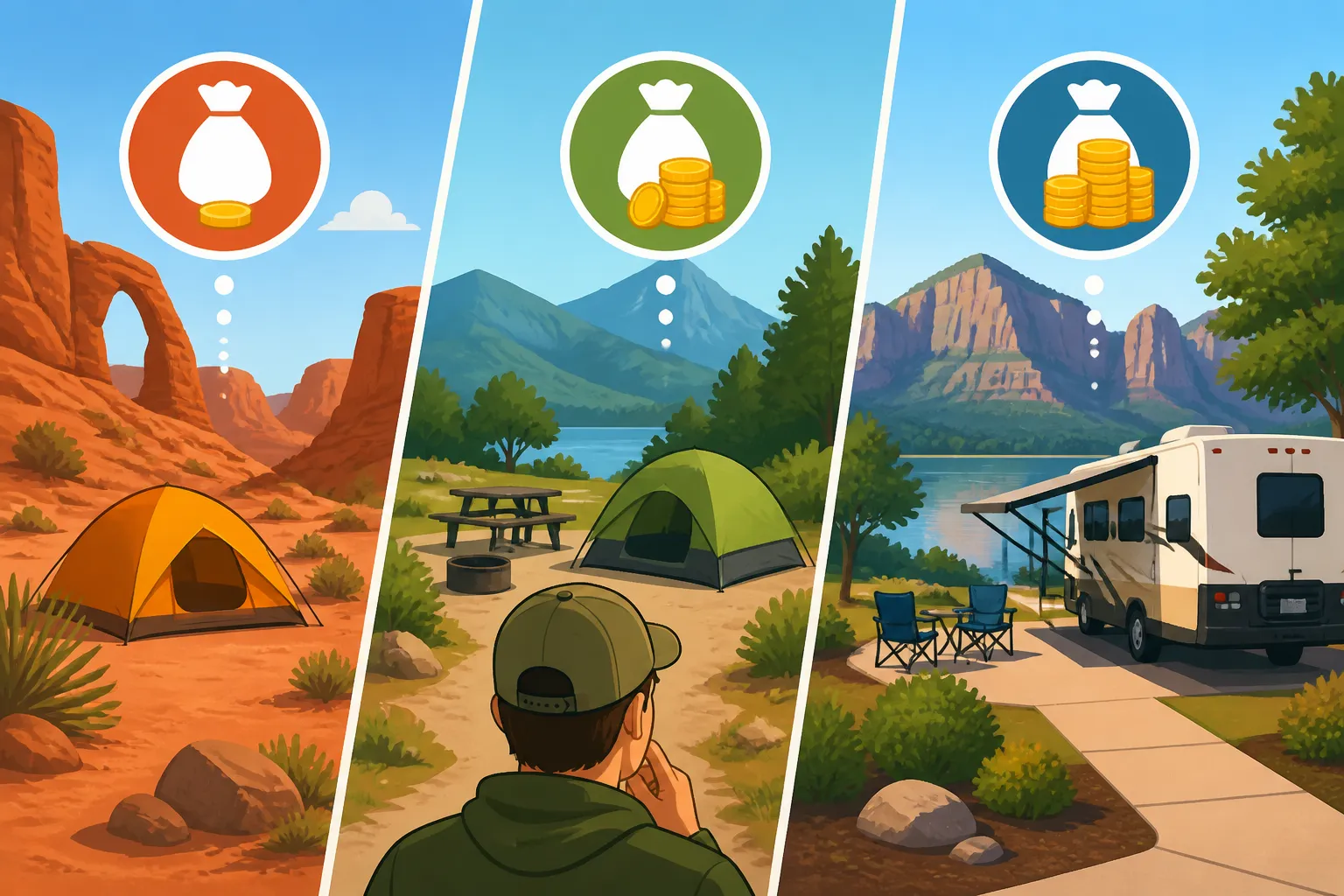
The available rate examples show why a simple “cheapest park” comparison can mislead. Two charges may be close or even match while the campsite types differ; another park may list different charges for sites with and without hookups. These figures are useful reference points, but they are not a complete price schedule for every campground or site in Utah.
| Example | Site type or service | Listed rate | What to check alongside the rate |
|---|---|---|---|
| Kodachrome Basin State Park, Basin Campground | Full hookups | $45.00 per night | Site capacity, vehicle details and the individual listing |
| Lakeview site | Partial hookups | $45.00 / night | Which services are included and what your setup requires |
| Bridger Bay Campground | No hookups | $30.00 per night | Whether a basic site fits your trip and what facilities are nearby |
| Bridger Bay Campground | Hookups | $40.00 per night | Which hookups apply and whether you will use them |
According to the Utah Division of State Parks and Recreation, Bridger Bay Campground costs $30.00 per night (no hookups)/$40.00 per night (hookups). That comparison illustrates how hookup availability can correspond to different nightly charges within a campground. It does not establish that the same difference applies at other parks, or that every site in either category has identical features.
The figures in this table are marked as of November 2026. Check the Utah Division of State Parks and Recreation’s official information before making plans, since rates and site details may change. When confirming, make sure you are looking at the specific campground and site category you intend to reserve, rather than relying on a general page or an older summary.
A table of examples can show patterns, but it cannot tell you why every rate was set. It does not establish that one park is more expensive because it has a particular view, busier dates or a specific amenity. Those may be sensible questions to ask, but do not assume that any one factor explains a listed rate unless the official site says so.
Think of the nightly charge as one data point in a comparison. The full listing should help you answer practical questions: Is the site tent-only or suitable for your rig? Are hookups available, and which ones? What are the stated occupancy and vehicle limits? Does the charge include park entry? Are there separate charges you need to account for? If any of those details are unclear, verify them with the park’s official information before committing.
For a wider look at how prices can differ between campsites, How Much Do Campsite Prices Vary Across Utah State Parks? is not a listed title, so there is no internal link to use here; instead, consult the exact park and site details. To understand how rate schedules may relate to busy periods, see How Do Peak-Season Campsite Rates Work at Utah State Parks? and confirm the current dates and terms directly with the official reservation information.
Why rates can differ between parks
There is no single detail that explains every difference in campsite prices. A useful comparison starts with the site category and its included services, but it should also account for how each park describes its facilities and what the reservation listing says is included. The important point is to distinguish a confirmed detail from a guess about the reason for a price.
Hookup availability is one confirmed way the examples differ. Bridger Bay lists one charge for a campsite without hookups and another for a site with hookups. That tells you to compare service levels when evaluating the rate. It does not tell you whether hookups are the only consideration behind the price, or whether a similar price structure exists elsewhere.
The campsite itself may also have characteristics worth comparing, such as its layout, access, capacity or relationship to campground facilities. These details can affect whether the site works for your group, even if the nightly charges are similar. However, don’t treat an attractive feature as proof that it explains a rate. Use it to judge suitability, and rely on the official listing for any stated pricing basis.
The surrounding park experience can be part of your decision too. People choose state parks for different reasons, and a campsite that is convenient for one itinerary may be a poor match for another. Location and setting can matter a great deal to visitors, but they do not necessarily explain a particular listed price. Compare the value to your own plans rather than inferring a park’s pricing formula from the scenery or popularity.
Dates may also matter when you compare listings. Some rate information can be tied to a season or a specific period, so check the dates shown for the stay you want. Do not assume that a rate you saw for one date applies to a different date. If a listing shows rates that vary by season or day, read its terms carefully and verify the relevant amount before completing a reservation.
The same care applies to occupancy and vehicle details. A site that allows your group and camping unit may be a better choice than a lower-priced site that cannot accommodate your setup. Kodachrome Basin’s listing, for example, includes its stated capacity and vehicle information alongside its site count and rate. Those details are part of what a camper should compare, not incidental fine print.
If you are deciding between parks, assess the trip as a whole: the drive, the kind of camping you want, the services you need and the activities you plan. The goal is not to find the lowest number in isolation. It is to find a site whose official terms and facilities match your needs, at a total cost you understand.
Compare the total cost without confusing the line items
A sound budget begins by identifying what the campsite charge covers. If park entry is included for the specific stay, don’t add a second entry charge to your estimate without checking the rules. If entry is separate for the visit you are planning, account for it as its own item. The distinction is important because a price comparison can look wrong when one listing includes entry and another charge is being compared without understanding that treatment.
Next, separate campsite charges from optional or additional costs. A reservation page may present costs in separate places, so review the checkout summary and the park’s information rather than relying on a search result or a single rate shown in isolation. Do not assume that a reservation-related charge, a service charge or an activity fee is included unless the official terms say so. For cost planning across the visit, see Budgeting a Utah State Park Weekend: Entry, Campsite and Extras.
If you have an annual pass, check whether it changes the entry portion of your visit and whether the campsite charge still applies. The pass and the overnight reservation are separate considerations. A pass may be relevant to admission without replacing the charge for a reserved campsite. Confirm the current terms for your pass and the site you are booking; don’t build a budget on an assumption that the pass covers every charge.
For each possible campsite, write down the same categories so the comparison stays fair:
- The nightly campsite charge for the dates you want.
- Whether park entry is included in that charge.
- The hookup services listed for the site.
- Any stated capacity or vehicle limits.
- Any separately listed charges that apply to your reservation or visit.
- The practical supplies or services you will need because of the site’s amenities.
This approach keeps a low nightly charge from looking automatically cheaper when the site requires extra planning, and it keeps a higher charge from seeming worthwhile merely because the listing has a longer feature description. A site with services you will not use may not offer value for your particular trip. A site with a higher charge may be a sensible choice if its features address a need you actually have.
Do not compare the word “hookups” as if it guarantees the same service everywhere. Check the listing for the actual connections offered. If you need a specific service, confirm it directly rather than inferring it from the category name. This is especially important when a site is described as partial hookup. The label indicates that the site is not described as full hookup, but the listing is where you should confirm exactly what is available.
Finally, verify the total before you submit a reservation. Look for the dates, site type, entry treatment and all charges shown in the official checkout process. If anything does not match the information you used to plan, pause and confirm the details through the park’s official website or reservation system. For a broader explanation of rate changes and where to confirm current amounts, see Fees Changed Since Your Last Trip? Where to Confirm State Park Rates.
A practical way to choose between similarly priced sites
When two sites have similar rates, resist the urge to use price as a tie-breaker immediately. Start with the trip requirements. Are you camping in a tent, a trailer or a motorhome? Do you need utilities at the site? Will your group fit within the posted limits? Does the site description work for your arrival, vehicle and gear? If a listing does not answer a key question, confirm it rather than filling in the gap yourself.
Then identify which amenities make a real difference to your visit. A hookup can be valuable if your setup depends on it, but it may not matter if you do not need it. A particular location in a campground may suit your plans, while another may be more convenient for different needs. A site’s value depends on the camper, not simply on its rate or the number of features listed.
Use a consistent checklist for each option:
- Price: Confirm the charge for the actual stay dates.
- Included entry: Check whether the campsite charge includes park admission.
- Services: Read the specific hookup description, not just the label.
- Fit: Review the listed capacity, vehicle details and site layout.
- Facilities: Check the park’s information for the amenities you expect to use.
- Rules: Read the terms that affect your group, camping unit and stay.
- Total: Review the final reservation summary for separately listed costs.
The checklist is not a substitute for official information. It is a way to notice what you need to verify and to compare the same points across different listings. If one site’s description is detailed and another’s is brief, that does not prove the second site lacks a feature. It means you may need to look further or ask the park.
If you are flexible, compare more than one campsite category or campground. A no-hookup site may be suitable if you are prepared to camp without site utilities. A partial-hookup site might meet some needs, while a full-hookup option could be useful for a setup that depends on its connections. Avoid paying for amenities solely because they sound convenient; equally, don’t choose a cheaper site if it makes the trip impractical.
For tent campers, think about the pad and the route from the vehicle, as well as the broader campground layout. For RV travelers, verify the site’s stated dimensions or vehicle limitations and the hookups offered. For a mixed group, clarify how occupancy and vehicles are handled. A site that appears economical may not be the right fit if its rules or layout do not suit the group.
When comparing parks rather than individual sites, include the rest of your itinerary. The most useful campsite may be the one that fits where you want to spend your time, rather than the one with the lowest listed rate. If you are weighing Utah’s different landscapes and campground styles, Mountain Lakes or Red Rock? Choosing a Utah State Park to Camp In can help frame that decision. For a wider comparison of what different site types offer, Camping in Utah State Parks: Tent Pads, Hookups, Yurts and Cabins is also relevant.
Verify the listing before you plan around a price
A rate found in an older article, saved note or search result is not a guarantee of what you will pay for a future stay. Park information can change, and site details can be more specific than a general campground summary. Before you choose, use the Utah Division of State Parks and Recreation’s official information and the official reservation system to confirm the rate and terms for the exact site and dates.
Check that the site category is the one you meant to select. Similar campground names or broad descriptions can conceal differences in services. Confirm whether the site has hookups and what kind. Make sure the stated capacity and vehicle details work for your party. Review the entry-fee treatment and the charges shown during checkout. If a detail is missing or unclear, contact the park using current contact information on its official website.
Keep a record of what you confirmed for the trip, especially if you are comparing several options or planning far ahead. Save the site description and the reservation summary in a way you can refer to later. If conditions, availability or pricing details change, return to the official listing rather than assuming that your earlier comparison remains accurate.
It is also useful to separate price questions from availability questions. A rate tells you what a listed site costs under the stated terms; it does not mean that the site is available for your dates. Likewise, seeing a campsite online does not by itself tell you that a particular rate or amenity applies to every nearby site. Confirm the exact reservation and follow the instructions shown by the official system.
If a rate seems out of line with what you expected, look for a straightforward explanation in the listing: site category, hookups, dates, entry treatment and included features. If those details do not clarify the difference, avoid guessing. Ask the park for clarification through the contact details on its official website. That is more reliable than assuming the difference comes from demand, scenery, amenities or another factor not stated in the official information.
The practical takeaway is simple: compare like with like, separate campsite costs from admission and other charges, and judge amenities by whether they solve a need for your trip. A price can be useful only when you understand what it buys and what it leaves out.
Frequently Asked Questions
Why can two Utah state park campsites have different rates?
Campsites can differ in their listed services and site details. Compare the specific amenities, dates and terms rather than assuming a single factor explains the difference.
Does a campsite charge include park entry?
Some rate information specifies that entry is included. Check the official listing and reservation details for your campsite and visit rather than assuming the same treatment applies everywhere.
Are sites with hookups always the better value?
Not necessarily. Hookups may be valuable if your camping setup needs them, but a site without hookups may suit your plans just as well. Compare the actual services with what you expect to use.
Where should I confirm a Utah campsite’s current price?
Check the Utah Division of State Parks and Recreation’s official information and the official reservation system for the exact campground, site and dates. Review the final charge before completing the reservation.
Sources
- Utah Division of State Parks and Recreation — Camping and Yurts | Utah State Parks (checked November 23, 2026)
- Utah Division of State Parks and Recreation — Park Fees | Utah State Parks (checked November 23, 2026)
- Utah Division of State Parks and Recreation — Camping and Lodging | Utah State Parks (checked November 23, 2026)
- Utah Division of State Parks and Recreation — Camping and Lodging | Utah State Parks (checked November 23, 2026)
Disclaimer
This article is for general informational purposes only and does not constitute professional advice. Laws, prices and regulations vary by location and change over time. Consult a qualified professional for guidance on your specific situation. Utah Camping & RV is not a government agency and is not affiliated with any government agency.