Mountain Lakes or Red Rock? Choosing a Utah State Park to Camp In
Utah campers often have to choose between cooler mountain scenery and the striking, exposed landscapes of red-rock country. The right fit depends on more than the view: season, shade, water access, campsite style, driving plans and tolerance for weather all matter. Here’s how to compare the two settings and choose a state park that suits the trip you actually want.
What changes between mountain-lake and red-rock camping
Mountain and red-rock settings can feel like different kinds of trips, even when both involve the same basics: arriving at a campsite, setting up, eating outdoors and exploring nearby. The setting changes how you plan for weather, what you want to do during the day and how much comfort matters once you return to camp.
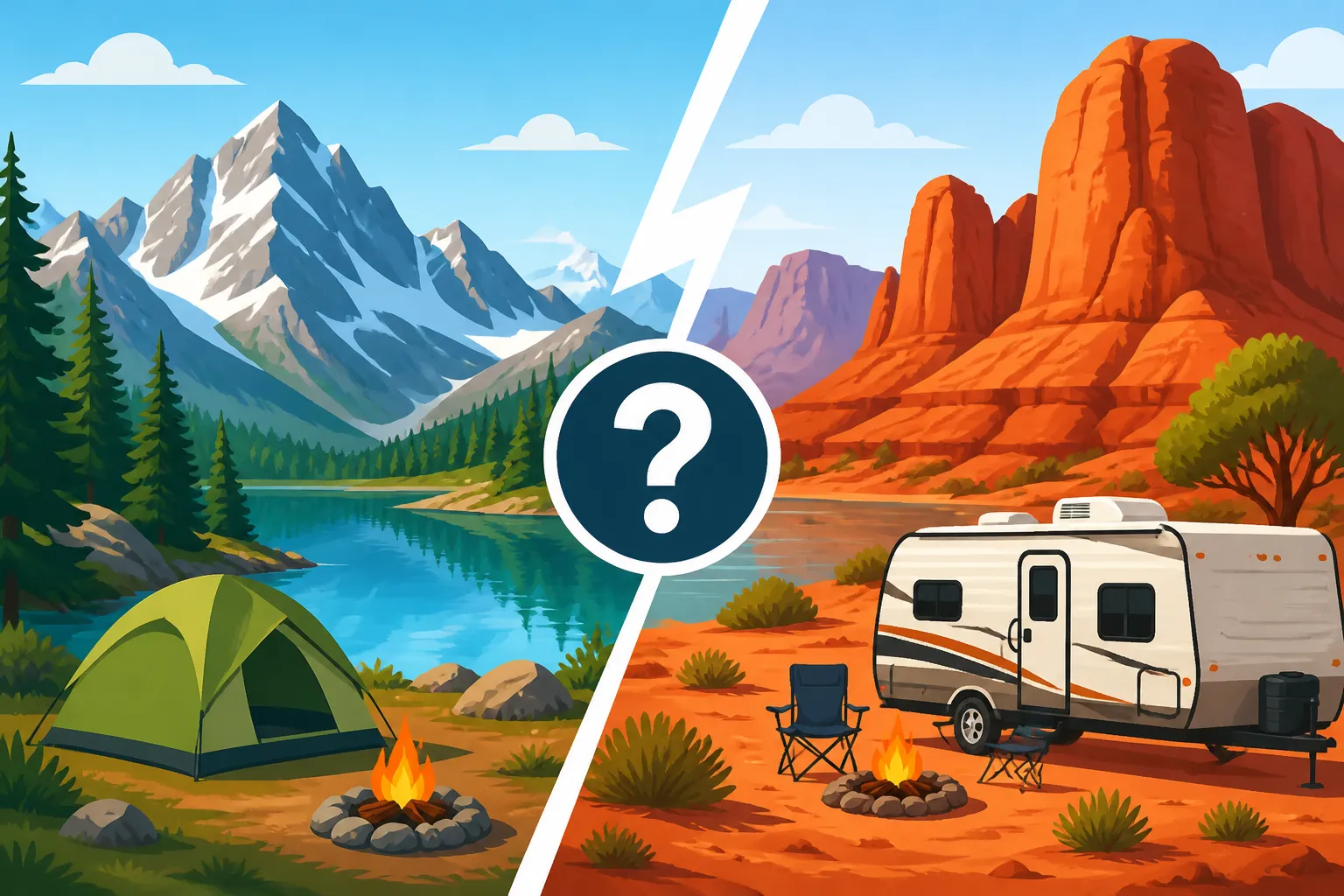
Mountain-lake camping tends to appeal to people who want cooler-feeling surroundings, water-oriented recreation and a landscape that feels green or wooded. Red-rock camping tends to suit travelers drawn to open views, sandstone scenery, dramatic light and a more exposed desert setting. Those are broad contrasts, not guarantees about a specific campsite. A site’s shade, elevation, water access and amenities depend on the park and campground, so check the individual listing before making plans.
| Consideration | Mountain or lake setting | Red-rock setting |
|---|---|---|
| Main appeal | Water, mountain scenery and a cooler-feeling outdoor setting | Rock formations, open views and strong landscape character |
| Weather planning | Check temperatures, wind and the chance of changing conditions | Plan carefully for sun, heat, wind and limited shade |
| Daytime activities | Look into water access and nearby options that fit your group | Look into trails, viewpoints and other activities the park offers |
| Campsite comfort | Confirm shade, hookups, restrooms and site layout | Confirm shade, water availability, surface and distance to facilities |
| Best fit | Campers who want a base for lake or mountain-oriented days | Campers who want a desert landscape and are ready to plan around exposure |
| Key question | Does the campground support the water or mountain experience you want? | Can your group stay comfortable through the hottest or windiest part of the day? |
The table is a starting point, not a substitute for checking current park details. A lake-oriented park may still have a site with little shade, and a red-rock campground may offer facilities that make a stay comfortable. The labels describe the setting; they do not tell you everything about the particular place where you’ll pitch a tent or park an RV.
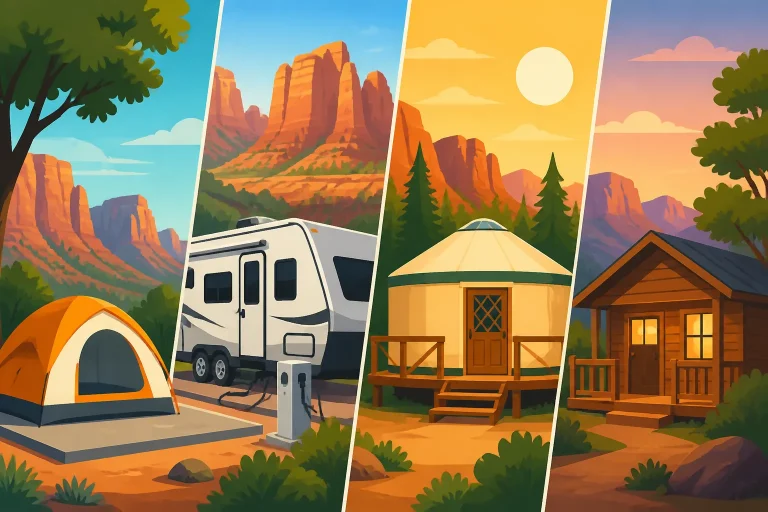
Utah’s landscapes also vary within each broad category. “Mountain” does not automatically mean a remote campground, and “red rock” does not automatically mean primitive camping. Utah State Parks offers full-hookup RV sites to secluded tent pads, according to the Utah Division of State Parks and Recreation. The right question is not whether one landscape is inherently better, but whether the park’s actual campsite options match your equipment, group and expectations.
For an overview of the range of options, see Camping in Utah State Parks: Tent Pads, Hookups, Yurts and Cabins. If you are still deciding between an RV and a tent, Which Utah State Park Fits a First Camping Trip? can help you think through the practical trade-offs.
Match the landscape to the season and your comfort needs
Season can change the character of a campsite as much as scenery does. Mountain destinations may have a shorter or more changeable camping season than lower-elevation areas, while red-rock destinations can be demanding when strong sun and heat coincide with daytime plans. These are reasons to check conditions, not assumptions that every campground follows the same pattern.
Before choosing a park, consider what the weather will mean for your whole day—not only the hours you spend at camp. A site that looks appealing in a listing may feel very different when you are cooking, resting or helping children stay comfortable. A trail or viewpoint can also be harder to enjoy if the timing, shade or water plan does not suit the conditions.
Think beyond daytime temperatures
A destination can feel pleasant during the day and still be uncomfortable after sunset, or the reverse. In a mountain setting, prepare for the possibility of cool evenings and changing conditions. In exposed red-rock country, plan for direct sun and the possibility that shade will be limited. Pack for the range of conditions you may encounter rather than relying on one daytime forecast.
Look at campsite photographs and the site description for details that affect comfort: shade structures, natural shade, distance from facilities, surface type and exposure to wind. Photos may not show how shade changes during the day, and a campground map can reveal distances that are hard to judge from a single image. If a feature matters to your group, confirm it with the park rather than assuming it is included.
For more specific planning around desert conditions, read Desert Heat at Utah State Parks: Water, Shade and Sun Safety. If your trip is near a seasonal transition, Winter Closures, Spring Crowds, Summer Heat: A Utah State Parks Year offers a useful reminder to check what is open and what conditions to expect.
Plan for changes, not just the forecast
A forecast helps, but it does not replace a flexible plan. Build in an alternative for a hot afternoon, a windy stretch or a cold evening. That might mean choosing a campsite with facilities that make downtime easier, planning outdoor activity for a more comfortable part of the day, or keeping an indoor lodging option in mind.
If you are bringing a tent, consider how its design and setup suit the conditions you could encounter. An exposed site may call for a different approach to shade and wind than a sheltered campground. If you are bringing an RV, think about whether your planned site has the services you need to stay comfortable. Confirm the exact amenities and site fit with the official listing; do not assume that every site in a campground has the same layout or hookups.
For trips during hot weather, be realistic about how much time your group will want to spend outside. A scenic location can still be a poor match if your plans require being outdoors through uncomfortable conditions and there is little chance to rest in shade. Conversely, a cooler-feeling mountain destination may be appealing but still require warm layers and a flexible schedule.
Consider the whole group
A landscape that excites one traveler may not work as well for everyone. Children, older adults, people with mobility needs and first-time campers may care more about nearby restrooms, dependable access, shade or a straightforward campsite setup than about the most dramatic view. A trip can still feel special without choosing the most exposed or remote-looking location.
Think about who will handle meals, sleeping arrangements, carrying gear and moving around the campground. A site that requires a longer walk with equipment may be manageable for one group and frustrating for another. If access is important, ask the park about the route to the site and nearby facilities, and use Accessible Camping and Lodging Options Across Utah State Parks to identify questions worth asking.
Choose a campsite style before choosing a view
A beautiful setting does not guarantee a comfortable campsite. First decide what kind of overnight setup works for your party, then compare parks that offer that type of stay. This keeps the search grounded in practical needs rather than letting a photograph make the decision for you.
Start with the basics: Are you sleeping in a tent, bringing an RV, or looking for a roofed option? How much equipment do you need to carry? Do you need hookups, or are you comfortable without them? Will you prepare meals at camp? Does anyone in your group need easier access to a restroom or a more sheltered sleeping space? Answering those questions can narrow the options before you compare scenery.
Tent campers
Tent campers should check the site surface, pad dimensions, shade, distance from parking and the route between the vehicle and the sleeping area. A scenic site may be less appealing if your tent does not fit well or if moving gear there is difficult. Look closely at whether a listing describes a walk-in or hike-in site, and verify what equipment the site can accommodate.
Do not assume every tent site offers the same level of privacy or shelter. Some campsites are close to neighboring sites, while others may feel more secluded; the park’s map and site details are better guides than the landscape category alone. Choosing a Campsite in a Utah State Park: Views, Restrooms, Neighbors can help you compare those factors.
If the site does not include hookups, plan for the needs that would normally be covered by them. Check what water and restroom facilities are available, and determine how far they are from your site. For a closer look at lower-amenity camping, read Standard Sites Without Hookups: Utah State Park Camping on a Budget and Primitive Campsites at Utah State Parks: Water, Toilets and Fees.
RV travelers
RV travelers should match the vehicle to the listed site rather than assume that a campground can accommodate any rig. Check the site’s stated length and layout, whether it is back-in or pull-through, and which services are connected at the site. A full-hookup site can simplify a stay, but it may not be necessary if you are comfortable managing water and waste another way.
In mountain and lake settings, think about access as well as scenery. In red-rock settings, think about the approach road, turning space and the specific site surface. Use official campground details to verify the route and any vehicle-fit limits before traveling. The broad description “RV-friendly” may not answer whether your particular setup fits the site.
If hookups are important, compare the exact services rather than relying on a general label. A campsite may offer electricity without water or sewer, or it may have no utility connection. For a closer look at what each type means, see Full, Partial or None: Matching Your Rig to a Utah Hookup Site. If your plans include dry camping, Packing for a Dry-Camping RV Trip in Utah’s Desert can help you consider supplies and comfort.
Cabins, yurts and other roofed stays
A roofed stay can make sense if your group wants shelter without bringing a tent, or if you want more protection from changing weather. But the word “cabin” or “yurt” does not tell you what is inside. Bedding, cooking equipment, heating, air conditioning, restrooms and nearby facilities can vary, so read the specific listing and ask the park about anything essential.
Utah State Parks has options across different kinds of stays. For example, the Utah Division of State Parks and Recreation lists three campgrounds, two cabins, one yurt and one cottage at Wasatch Mountain State Park. That gives campers a range of formats to compare at a mountain-oriented park, but it does not mean every type is available on the dates you want or that the units have identical features.
Before choosing a roofed stay, decide which amenities are necessities and which are conveniences. A kitchenette may matter more than a view if you plan to prepare meals, while a nearby restroom may matter more than a private bathroom. If you need details about a particular unit, use Questions to Ask Before Booking a Utah State Park Yurt or Cabins With a Bathroom Inside or Restrooms Nearby at Utah State Parks.
Compare Utah park examples without assuming every site is alike
Utah has a broad state park system, so choosing by landscape can be a useful first filter. The Utah Division of State Parks and Recreation describes the system as 46 heritage, scenic, and recreation parks. That range means “state park camping” covers different environments and styles of trip, not a single standard campground experience.
For a mountain-oriented option, Wasatch Mountain State Park is a natural starting point for comparing campsites and lodging formats. For campers looking for a campground described as available across the year, Rockport State Park is another park to investigate: the Utah Division of State Parks and Recreation says it has over a hundred campsites available for camping year-round. Check the specific campground listing for current site details and conditions before planning around that general availability.
Red-rock parks offer a different kind of scenery, but do not choose solely by a park’s name or a photograph. Consider destinations such as Snow Canyon, Kodachrome Basin, Goblin Valley and Dead Horse Point as examples to research, then compare what their individual listings say about camping, shade, site style and access. The names suggest distinct landscapes, but campsite features and availability must be checked directly.
For individual campground comparisons, see Wasatch Mountain State Park Camping: Hookup Loops, Tent Sites, Lodging, Rockport State Park Campsites: Year-Round Camping and Gate Hours, Snow Canyon State Park Camping: Hookup, Standard and Group Sites and Kodachrome Basin State Park Camping: Hookups, Dry Sites and Huts. Those park-specific resources can help you move from a broad landscape choice to questions about the actual campsite.
Treat availability as part of the decision
A park can be a strong match in theory and still not work for your dates or equipment. Check the official reservation information for the type of site you want, and read the listing carefully before committing. If your preferred campground is full, consider whether another park with similar scenery or a different campsite style would still meet your needs.
When comparing availability, be precise about what you are searching for. A tent site is not interchangeable with an RV site, and a group campsite is not a substitute for several nearby individual sites unless the park’s details and your group’s needs line up. A roofed unit may offer a different set of amenities from a campsite, so confirm exactly what the booking includes.
If you are weighing a mountain destination against a red-rock destination, compare options that are actually available rather than comparing an idealized version of one park with the available version of another. The site listing, access information and weather outlook are all part of the decision.
Plan the days around the campsite you choose
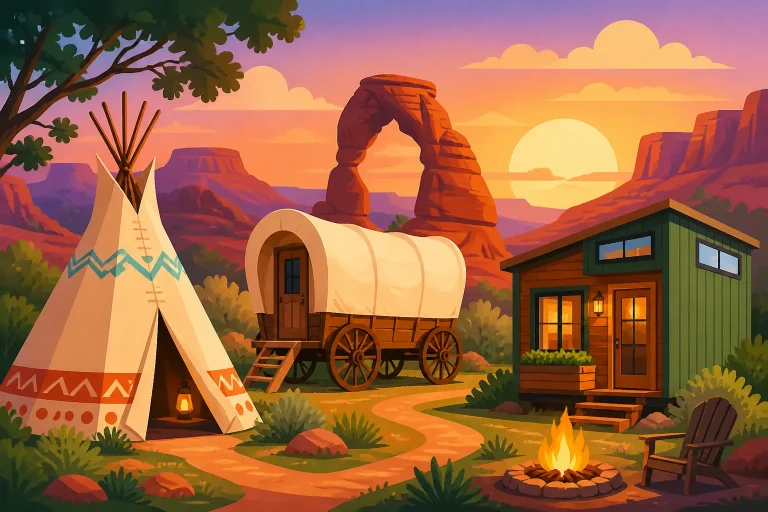
The campground is a base for the trip, not the whole trip. Think about what you want to do once camp is set up, and choose a park that makes those plans practical. A mountain-lake stay may appeal if you want water-related activities or a cooler-feeling setting. A red-rock stay may be the better fit if your group is drawn to dramatic stone scenery, open country and landscape-focused outings.
Check what activities the park allows and provides rather than assuming that a landscape guarantees a specific experience. A lake in the area does not automatically mean a campsite is waterfront or that swimming access is close. A red-rock view does not guarantee a trail begins beside your campsite. Look up the park’s current facilities, recreation options and any relevant conditions before you build the day’s schedule around them.
Leave room for rest
Many campers plan every day around activities and underestimate the value of comfortable downtime. The campsite may be where someone naps, reads, cooks, cools off or takes a break from a busy outing. Consider whether the setting has enough shade or shelter for those pauses, and whether your group has a plan for staying comfortable when the weather is not ideal.
This matters especially when traveling with children or people who prefer a slower pace. A quiet afternoon at camp can be a better plan than pushing through an uncomfortable outing. If the chosen setting is exposed, bring shade equipment only after confirming that the park allows it at your site. How to Check the Rules on Shade Canopies at a Utah State Park Site is a useful place to start.
Keep the itinerary flexible
A flexible itinerary helps if the forecast changes, a facility is unavailable or a planned activity does not suit the group. Have a backup plan that does not depend on the same conditions as your first choice. For example, if an outdoor plan depends on comfortable temperatures, identify a lower-effort alternative. If your trip centers on water access, confirm conditions and access before setting out.
A short list of questions to settle before departure can prevent last-minute surprises:
- What is the exact campsite type, and does it fit your tent or vehicle?
- Which facilities are included, and which are shared or located elsewhere?
- What weather conditions could affect comfort at the site?
- Is the planned activity available from the park, or will it require a separate drive?
- What is the backup plan if the weather or access does not cooperate?
For help organizing the details, Reading a Utah State Park Map Before You Arrive can help you understand the campground layout, while Checking Water Conditions Before Swimming at a Utah State Park is relevant if swimming is central to your plans.
Use a simple decision process before booking
When two landscapes both sound appealing, use a consistent comparison instead of deciding based on a single photo. The process below works for tent campers, RV travelers and people considering roofed lodging.
- Name the trip’s main purpose. Decide whether the priority is mountain scenery, water-oriented recreation, red-rock views, comfortable base camping or a particular activity. If several priorities matter, rank them informally.
- Set the comfort requirements. Identify the essentials: shade, hookups, a particular kind of restroom access, a roofed sleeping space, room for a specific vehicle or an easier route to facilities.
- Check the season and conditions. Look at expected temperatures and other conditions for the dates you plan to travel. Think about evenings as well as afternoons, and consider what your group can comfortably handle.
- Compare actual campsites. Read the specific site descriptions and maps for each option. Confirm tent fit, RV fit, utility connections, surface, access and the distance to facilities.
- Check the daily plan. Make sure the activities you want are available and that getting to them makes sense from the campground. Confirm any water or trail conditions that could affect your plans.
- Keep a backup. Identify another site, park or activity that would still make the trip worthwhile if your first option is unavailable or conditions change.
This approach can prevent a common planning mistake: choosing a park for its scenery and only then discovering that the campsite does not match your equipment or comfort needs. It also helps clarify when a trade-off is worthwhile. You might accept a more basic site for the landscape you want, or choose a more equipped campground because the convenience matters more to your group.
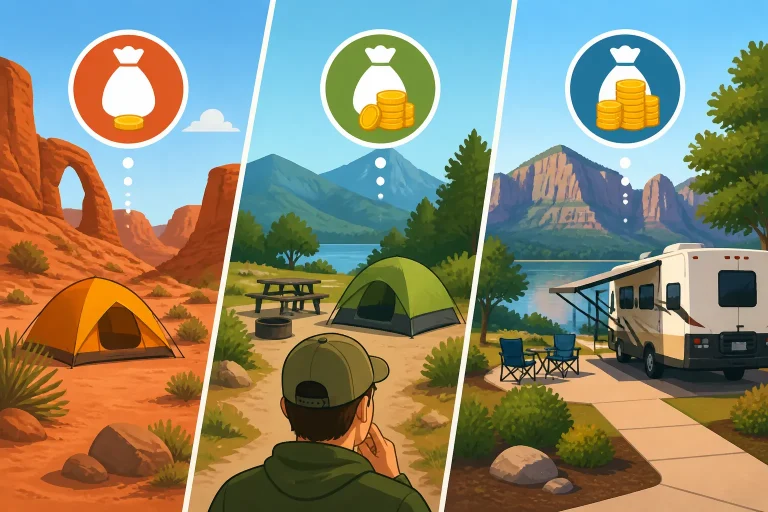
If cost is part of the comparison, separate campground charges from park entry and other possible expenses. Fees and inclusions can vary, so check the official park information for current details. Entry Fee, Campsite Fee or Both? How Utah State Parks Charge explains why it helps to compare the full cost of a trip rather than looking at the campsite alone.
Make the final choice by fit, not by category
A mountain setting is not automatically the comfortable choice, and red-rock camping is not automatically rugged or inconvenient. The best option is the one whose site, timing and amenities align with your trip. A tent camper who values shade may prefer a particular site over a more famous view. An RV traveler may value the right hookups and access more than whether the landscape is mountainous or desert. A family may find that nearby facilities and a flexible schedule matter most.
If you are torn between two parks, compare the same details for each: campsite layout, weather considerations, services, activity access and backup options. Do not compare one park’s best features with another park’s uncertainties. Get the practical information for both, then decide which trade-offs you would rather manage.
For more help with planning the overall stay, Family Tent Camping at a Utah State Park: Picking the Park and Site focuses on site fit and group needs. If you are trying to narrow down lodging rather than campsite landscapes, Year-Round Yurts, Cabins and Cottages in Utah State Parks is a useful next read.
Frequently Asked Questions
Are mountain-lake parks always cooler than red-rock parks?
Not necessarily. Conditions vary by location, elevation, season and weather. Check the forecast and the park’s current information, and plan for both daytime and nighttime comfort.
Does a red-rock campsite mean there will be no shade or water?
No. The landscape category does not tell you the amenities at a specific campsite. Check the site listing for shade, water access, restrooms and other facilities before choosing.
How should RV travelers compare mountain and red-rock parks?
Start with the exact site requirements: vehicle fit, access, hookup type and location of facilities. Then weigh those details against scenery, activities and the conditions expected during your trip.
Is Wasatch Mountain State Park only for tent camping?
No. The Utah Division of State Parks and Recreation lists multiple campground and lodging types at the park. Check the specific listing for current availability and the features of each option.
Sources
- Utah Division of State Parks and Recreation — About Us | Utah State Parks (checked November 22, 2026)
- Utah Division of State Parks and Recreation — Camping and Lodging | Utah State Parks (checked November 23, 2026)
- Utah Division of State Parks and Recreation — Rockport State Park | Utah State Parks (checked November 23, 2026)
- Utah Division of State Parks and Recreation — Adventure on Land | Utah State Parks (checked November 22, 2026)
Disclaimer
This article is for general informational purposes only and does not constitute professional advice. Laws, prices and regulations vary by location and change over time. Consult a qualified professional for guidance on your specific situation. Utah Camping & RV is not a government agency and is not affiliated with any government agency.